The Dash Platform
SBS drives the car.
Ledger Hub Networks is the engineers — the ~95% of the team the cameras never show.
Engine first. Factory second. Telemetry everywhere.
The driver just races.
~95% of the organization never touches the car at a race
FIA-capped trackside crew — the visible enterprise
Mclaren F1's headcount by March 2026 — before scoring a single point. They entered with a customer engine but built the full enterprise first, because the enterprise — not the engine — is the barrier to entry.
| Fans see | Reality | The Dash equivalent |
|---|---|---|
| The driver | 1 of ~1,300 — the only visible human | The Frontend everyone sees |
| The car | ~14,500 components, upgraded every 2 weeks | ~1,000,000 lines of logical code |
| The pit stop | 20 people, choreographed, drilled | Deployment & incident response |
| The garage | 60-person capped trackside crew | Customer-facing ops |
| (invisible) | Factory — aero, simulation, manufacturing | Engineering, data, infrastructure |
| (invisible) | HQ mission control, live telemetry | Observability — monitor.sbsdash.com |
| (invisible) | Cost cap, FIA audits, parc fermé | Gates, signed audit log, SEC-grade governance |
| (invisible) | Freight, supplier network | Connectors — WideOrbit, Oracle, Counterpoint |
The sport itself prices the enterprise, not the star
The Drivers' Championship
The title on every broadcast, every headline, every highlight reel. The driver is ~0.15% of headcount and ~100% of the perception.
The Constructors' Championship
Prize money is distributed on the Constructors' standings — the sport's own accounting says the enterprise is the asset.
One more thing F1 teaches: compliance is the design constraint, not the enemy
The 2026 cost cap is $215M per team per season, with annual audits — Red Bull was penalized for a breach. Infrastructure sits under a separate $45M / 4-year CapEx allowance. The fastest engineering organizations on earth innovate inside a hard-capped, audited rulebook. That is exactly how you build AI under SEC constraints — and it's why this deck spends a full chapter on gates before it ever shows you a pipeline.
Everyone is selling you a driver. We're going to show you a constructor.
The stack isn't slow because it's legacy.
It's slow because people are the integration layer.
Legacy systems
WideOrbit · MusicMaster · SIMS · Oracle · ADP · SAP · VCreative · CPT · LaMusica — none of them talk to each other.
Critical departments
Sales, Finance, Traffic — carrying the revenue cycle on manual handoffs and inboxes.
Order-to-cash SLA
Step 1 → Step 4 in WideOrbit alone. The clock is always running, and humans are the bottleneck.
Nordic Agents on the Orchestrator
Invoicing, lead response, follow-ups, reconciliation, scheduling — a capable back office and a tireless sales assistant, governed by the gates.
Every lead, every insertion order, every invoice crosses a human handoff. Speed-to-lead decays over a weekend. This is the gap The Dash was built to close.
The Engine
Every car on the grid starts life in a factory. NornGate is ours — the power unit, the aero department, the race engineers. Five layers rival teams spend a season assembling, delivered as one bolted-together, dyno-tested system.
Five layers. One platform. Nothing to assemble.
This is the safety DNA
Layer 3 — the gates — is what makes unattended AI safe. Nothing touches customers, books, or systems without passing the gates first. The Dash inherits this entire layer.
Why it matters for the bill
The bulk of work never touches per-token retail pricing. Frontier models are reserved for problems that earn their price.
Three numbers a platform is judged by
Pennies, not tokens
Majority of workloads run on NornGate's own model at GPU cost. You stop paying frontier prices for form-letter work — and one platform replaces the pile of overlapping subscriptions.
Hours shift to winning work
The repetitive layer — invoicing, chasing, data entry, status emails — runs itself. People's hours move to proposals, relationships, judgment calls. Same payroll, more produced.
Speed-to-lead, 24/7
Every inquiry gets a substantive reply in minutes — nights, weekends, trade-show days. Follow-up sequences never get forgotten.
The contrast: most SMEs "doing AI" run a duct-taped pile — a chatbot here, an automation tool there, five separate bills, and nobody can say what the AI actually did last month. NornGate is one system, one bill, every action logged, signed, and inspectable.
The Proof
Before pointing the engine at a broadcaster, it was stress-tested under the hardest governance conditions that exist: the operating cadence of a U.S. public company.
A governed AI executive bench, running in production
Six autonomous AI executives run the operating cadence of a public company — drafting, reconciling, and disclosing in real time — while every material action stays gated behind the human board.
- ▸Bill · AI CEO — MD&A narratives, board synthesis, shareholder comms
- ▸Tom · AI CFO — GAAP-aware reconciliation, quarterly close, XBRL validation
- ▸James · AI GC — Reg FD sweeps, 8-K materiality, §16 tracking
- ▸Lisa · AI COO — transfer-agent interface, OTCIQ portal, cadence tracking
- ▸Mary · AI CMO — IR content, embargoed PR, selective-disclosure filter
- ▸Robert · AI CTO — infrastructure posture, security monitoring, audit commits
Production infrastructure, operated in real-world SEC-reporting conditions. This is not a demonstration. It is running software.
Every agent has a SOUL and a SKILL — written down, versioned, public
Character & values
Each agent carries a defined character — an ethical anchor (Aristotelian, Kantian, Rawlsian), a name, a posture. Bill synthesizes; Tom attests; James guards privilege. Identity is explicit, not emergent.
Operational capability
Each agent's skillset is a bounded scope document — what it may do, what it may touch, what it must never do. Limits are written before the agent runs, not discovered after.
Why this is the most credible artifact in the deck
The specification is Caremark-grade: a hash-chained, seven-year WORM-archived audit trail under 17 C.F.R. § 240.17a-4(b)(4) — the documentary substrate for board-level monitoring defense, SOX §302/§906 certifications, and books-and-records demands. Changing a canonical file requires Board-Required authorization through the Governance Gate.
Every action passes a gate. Every gate decision is on the record.
| Authorization class | Meaning | Examples |
|---|---|---|
| PAWPPre-Authorized Within Parameters | Inside written bounds — executes automatically | Draft a proposal from live data · pull A/R aging |
| SA / DASingle / Dual Approver | Named human must approve first | Write an IO to traffic · send outbound comms |
| BRBoard-Required | Board-level sign-off before anything moves | Filings · material contracts · canonical spec changes |
Default-deny
What isn't explicitly allowed doesn't happen. Fail-closed, not fail-open.
Hash-chained
Each audit entry commits the prior entry's SHA-256 — retroactive edits are detectable. Seven-year retention.
Dedicated environment
Per-subscriber isolated infrastructure — Vault namespace, private DB schema, object-lock storage. Cross-access architecturally infeasible.
The Translation
We didn't impose a generic CRM on SBS. We documented how SBS actually works — order to cash, system by system, SLA by SLA — and built on top of the truth.
SBS order-to-cash: 15 steps, 6 swimlanes, 3 SLA timers
Steps 1–3 · WO Media Sales entry → order form (rate-card validated) → WideOrbit Cloud system of record · READY
Step 4 · Sales mgmt approval (GSM·NSM·LSM) — NO → returns to AE. Step 5 · Credit check — HOLD → returns to Step 1
Steps 6–9 commercial + programming logs merge → air log. 10–11 playout + as-run (missed spot → auto-makegood). 12–15 reconcile → invoice → Oracle → bank rec
The machine is already gated — by humans. Sales management approval and credit check are the two gates that already exist inside SBS's workflow. The Dash didn't add governance to SBS; it recognized the gates SBS already runs and automated everything around them.
The wiki: workflows written down,
versioned, agent-readable
wiki.sbsdash.com/books turns tribal knowledge into structured documentation — the bridge between the humans who run SBS and the agents who will assist them.
- ▸Order-to-cash flows for Radio and TV, side by side
- ▸System inventories, integration seams, protocol notes (REST · JDBC/ODBC · SFTP · flat-file)
- ▸Architecture models with Mermaid sources that render on the wiki
- ▸Versioned — the documentation changes when the workflow changes, not after
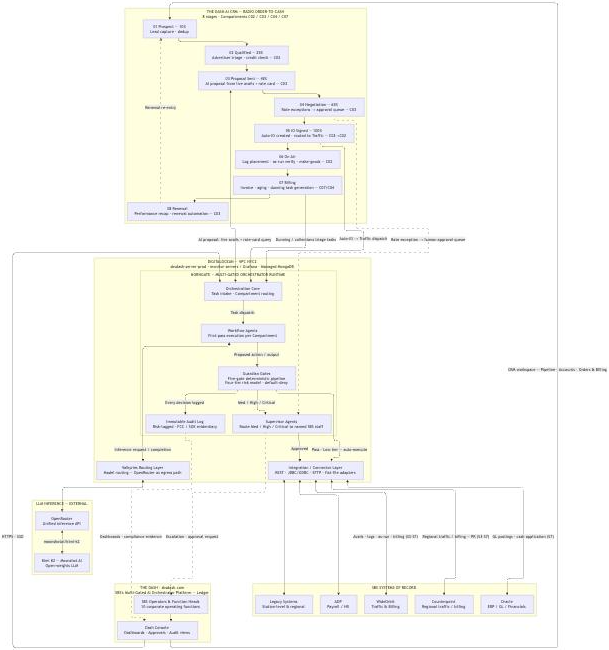
The Platform
Dedicated infrastructure, real-time observability, and a multi-gated AI CRM pointed at SBS's actual systems of record. This is The Dash.
No side door: every action enters through the Core and passes the Gates
▼
Kimi K2 served through OpenRouter behind Valkyries — a pass-through egress path, not a dependency. Model slug swappable without touching agent code.
Eight stages, every automation gated, every exit logged
The loop closes: Renewal re-enters as a Prospect — the pipeline feeds itself. Win probabilities are the forecast model: stage-weighted pipeline, continuously refreshed from what actually airs and bills in WideOrbit and Oracle, not from what reps remember to type.
Four risk tiers — the Executives.bot model, pointed at SBS
| Tier | Disposition | Path |
|---|---|---|
| LOW | Auto-execute | Gates → Connector → system of record → Audit |
| MEDIUM | Human approval required | Gates → Supervisor → named SBS staff → Connector → Audit |
| HIGH | Human approval required | Gates → Supervisor → named SBS staff → Connector → Audit |
| CRITICAL | Blocked — fail-closed | Gate-fail → Supervisor escalation → Audit. Nothing reaches the Connector. |
Proposal draft — S3
Agent pulls live avails + rate card, Kimi K2 drafts line items, gates pass on read-only data, seller reviews the draft.
Auto-IO to Traffic — S5
An order write to WideOrbit is never auto-executed. Named staff approve; response time is recorded and reported.
Policy breach — fail-closed
A rate below floor is proposed. G4 fails, the action dies at the gate, named staff are escalated, and the block lands in the audit log.
Dedicated droplets. Live observability. Not a demo tenant.
DigitalOcean · VPC NYC2
- ▸sbsdash-server-prod — production host
- ▸monitor-servers — observability stack
- ▸Managed MongoDB · isolated per deployment
- ▸Same per-subscriber isolation model proven at Executives.bot — Vault namespace, private schema, object-lock storage
The Dash is deployed — Phase 1 is running
- ▸The engine — NornGate multi-gated runtime, running on dedicated NYC2 infrastructure
- ▸The bench discipline — SOUL/SKILL-defined agents, five deterministic gates, four-tier risk, signed audit log
- ▸The knowledge — SBS's Radio & TV order-to-cash documented, versioned, agent-readable on the wiki
- ▸The integration plan — connector seams specified per system: WO Traffic API, Oracle JDBC, Counterpoint SFTP, ADP OAuth
- ▸The inference path — Kimi K2 via OpenRouter behind Valkyries; swappable without touching agent code
Phase 2 — in progress: operational CRM workflows on the 8-stage pipeline, live WideOrbit avail/rate-card reads, auto-IO dispatch, and LaMusica discovery.
The human workflow on top. The agent workflow underneath.
SBS's day
AE enters the order · manager approves · credit clears · traffic schedules · it airs · it bills. Unchanged.
The Dash's shift
Proposals drafted from live avails · exceptions routed to named humans · make-goods detected instantly · dunning queued · renewals never forgotten.
The record
Every action signed, risk-tagged, FCC/SOX-evidentiary — inspectable in the Console by SBS, by auditors, by counsel.
NornGate built the engine. Executives.bot proved the discipline under SEC scrutiny. The wiki captured SBS's truth. The droplets made it real. The Dash is where they converge.
Bring one process.
We'll put a figure on it.
One workflow you'd hand off tomorrow if you trusted it — proposal drafting, IO paperwork, dunning, renewal follow-up. We map it onto the gates, run it beside your current process, and show you the number.
sbsdash.com · wiki.sbsdash.com · monitor.sbsdash.com